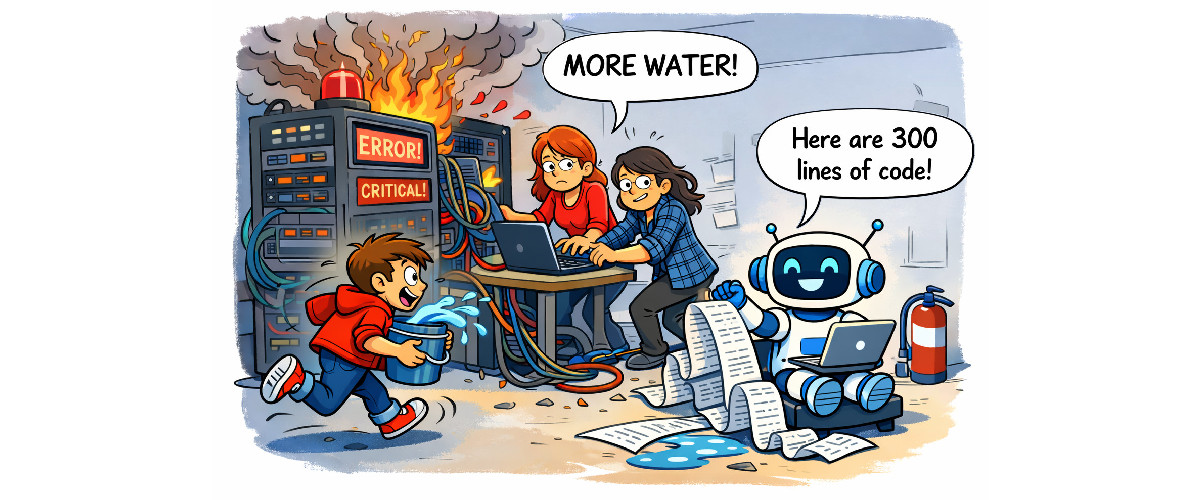
There’s a lot of discussion right now about AI replacing junior developers.
The argument sounds straightforward:
If AI can generate code, why hire someone whose job is to generate code?
The problem with that idea is simple. That was never the job.
What Developers Are Actually Paid For
Developers aren’t hired to type syntax. They’re not hired to memorize language quirks or remember the exact parameters of an API. They’re hired to:
- understand systems
- reason about tradeoffs
- design solutions that survive real-world use
- debug things when they inevitably break
- maintain software over time
Writing code is part of that work.
But it’s the visible artifact, not the value. Code is simply the medium through which decisions become real.
AI Generates Output — It Doesn’t Carry Responsibility
AI is very good at producing code.
It can write functions, generate tests, explain libraries, and suggest approaches. Sometimes impressively well.
But software development isn’t just producing output.
It’s deciding what output should exist in the first place.
AI doesn’t sit in architecture discussions.
It doesn’t negotiate product requirements.
It doesn’t decide when a solution is “good enough.”
It doesn’t carry the consequences when something breaks.
And when production goes down at 2 a.m., nobody opens a ticket for “the AI.”
Someone still has to understand the system well enough to fix it.
What Actually Changes
What AI really changes isn’t the need for developers.
It changes the baseline.
Software development has always evolved alongside better tools.
We moved from books to the internet.
From the internet to StackOverflow.
From StackOverflow to modern IDEs.
Each step removed friction.
Each step also triggered concerns that people would stop learning “the proper way.”
And yet the demand for developers kept increasing.
Not decreasing.
Better tools rarely remove work.
They shift it.
The Floor Moves Up
When a tool makes something easier, expectations change.
Boilerplate becomes faster.
Documentation becomes easier to navigate.
Small mistakes get spotted earlier.
This doesn’t eliminate developers.
It simply raises the floor.
A junior developer today can move past certain obstacles much faster than before.
They can explore ideas quicker, test approaches earlier, and get feedback immediately.
The learning curve doesn’t disappear. It just becomes steeper.
Why Juniors Still Matter
There’s another practical reason the “AI replaces juniors” narrative doesn’t hold up.
Software teams need future senior developers. Complex systems don’t maintain themselves. Companies need people who understand their infrastructure, their data, and their architecture over time.
That pipeline starts with juniors.
Every experienced developer used to be one.
Removing junior roles would mean removing the future maintainers of your systems — which is not a strategy most organizations survive for long.
And complexity in software rarely decreases. If anything, it accumulates.
What AI Actually Threatens
AI doesn’t threaten developers.
It threatens shallow skills.
Things like:
- memorizing syntax
- writing boilerplate from scratch
- copying patterns without understanding them
Those were never the hard parts of the job.
They were simply the most visible ones.
If someone’s entire value was typing code quickly, AI makes that less impressive.
But there’s another practical limitation people tend to overlook.
AI can only operate within the knowledge it was trained on.
It can’t write software in a language it has never seen.
It can’t reason about systems it doesn’t understand.
And when a problem moves outside familiar patterns, the confidence tends to drop quickly.
Humans, on the other hand, are surprisingly good at solving messy problems computers struggle with. Things like:
- navigating incomplete information
- inventing heuristics for difficult search problems
- making tradeoffs when there isn’t a perfect solution
Ask a computer to solve certain NP-hard problems optimally and it might run for centuries. Ask a human to come up with a “good enough” approach and they’ll often find something workable in an afternoon.
That kind of reasoning — approximation, intuition, experimentation — is a large part of real-world engineering. AI can help explore solutions. But it still relies on humans to recognize which ones make sense. And more importantly, which ones don’t.
The Job Isn’t Disappearing
AI isn’t removing developers from the industry.
It’s removing some of the friction around producing code.
That’s not a new pattern.
Every generation of programming tools has done the same thing.
The job doesn’t disappear.
The easy parts just get easier.
And when that happens, something interesting tends to occur:
The parts that actually require thinking become visible again.
A More Interesting Question
So maybe the real question isn’t whether AI will replace developers.
Maybe the more interesting question is this:
If tools can handle more of the syntax and boilerplate…
what part of programming actually matters?
Because programming was never really about typing in the first place.
And that’s where things get interesting.